(This article is based on an exclusive interview of eminent photographer Prashant Panjiar with Indian Documentary Photo Collective)
Never before has photojournalism faced a more curious paradox. On the one hand, photography is more accessible to every person today than it used to be. Whether with a DSLR or a phone camera, people are using photography to document their lives and times in vivid detail. But never before has making a living out of this practice been this tough, either.
If photojournalism or documentary practice is no longer what it used to be, and if it is difficult to make a living from it, how do current practitioners take its legacy forward?
Noted photographer, curator and journalist Prashant Panjiar has incisive answers and five decades’ worth of photojournalism experience to shape current day perspectives on this subject. His work has been capturing societal narratives and shifting cultural landscapes since the 1980s, documenting India in all its glorious, and sometimes sordid, detail. “I started working freelance in 1981, moving from Pune to Delhi to look for full-time work. There were few freelance photojournalism opportunities at the time,” he says. But Panjiar was working on one of the era’s most defining personal projects – from 1981 to 1984, he documented the life and times of Chambal’s most dreaded dacoit Malkhan Singh and his 13-year-long reign of terror. He had a ringside view of the 1982 negotiations between the Madhya Pradesh Government and Singh’s gang – he even spent several days with the dacoits, taking photographs and documenting moments for what would become a pivotal work in Indian photojournalism, using a Pentax camera and a borrowed Nikon. The work resulted in his first book, ‘Malkhan: The Story Of A Bandit King’; the resulting fame landed him a full-time photojournalist job with The Patriot in 1984.
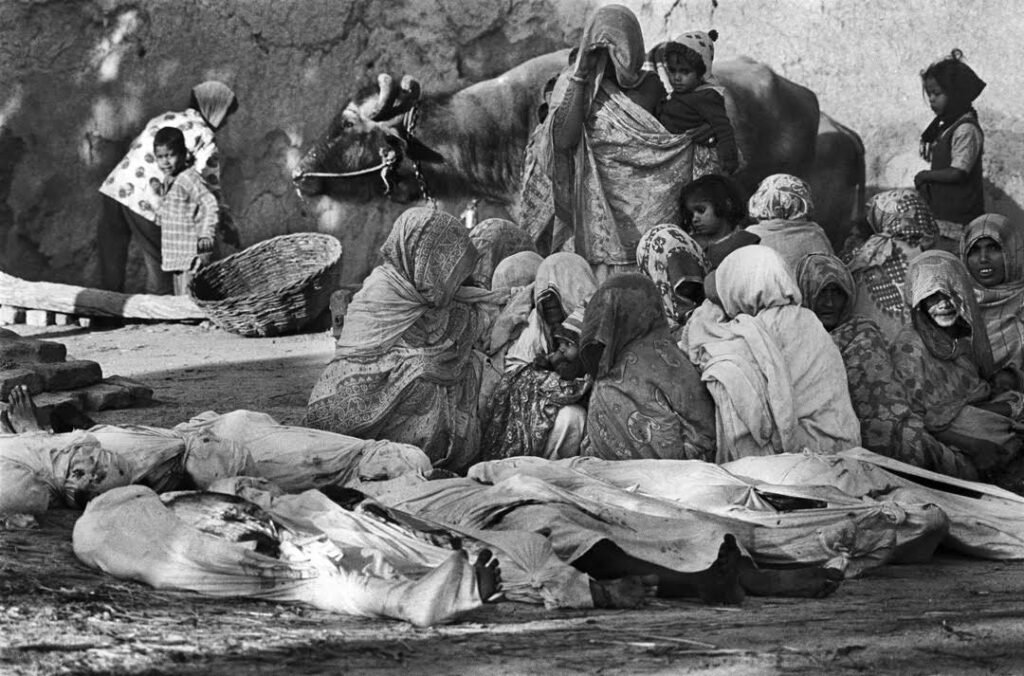
“It was the first newspaper in Delhi to adopt type settings using a computer, while others were still using letter presses,” he remembers. He went on to photograph some of the most formative events in India, like the Punjab violence that led to Operation Blue Star, the riots after Prime Minister Indira Gandhi was assassinated, and the Babri Masjid demolition in 1991, among others. Some of the best photo-editors, from Pablo Bartholomew to Raghu Rai, were his mentors.
However, Indian photojournalism dwindled over the years. There was a time when most of the top 10 photographers in India were journalists; this is no longer true. “Journalistic and documentary work is not necessarily viewed as news today,” Panjiar explains. “The kind of serious documentary work that looked at social issues appeared as independent projects only in 1990s India.” By the early 2000s, he began freelancing again, against the backdrop of declining opportunities, the shrinking of legacy publications, and the emergence of independent documentary work with NGO grants and self-funded projects. He became heavily involved in curatorial work after going through the ranks, from a photographer to a deputy editor. “Dinesh Khanna and I founded the Delhi Photo Festival in 2011 to offer photographers a platform to tell their stories without gatekeeping. We hardly make any money out of it, or from my work at the Nazar Foundation. But it’s my way of paying it forward for current and future photographers who are passionate about their craft.”
What’s the difference between erstwhile documentary photography and the social media-led technological evolution of today? “Publishing modes have changed dramatically, from print to the online medium. I can create an Instagram handle and upload whatever I want if mainstream media will not publish it. Earlier, all access and contacts were provided by the publishing house, but today, non-profits and others offer access.”
Adopting tech advancements is the only way forward. “We cannot stop the use of digital, or expect people to go back to analogue [simply for nostalgia’s sake]. People will not stop using computers and return to typewriters. But they can exercise the personal and artistic choice to shoot in a certain medium.”
He offers a realistic, hopeful perspective to aspiring photojournalists. “It is tough to make a living only from documentary photography. Diversify and find as many commissions as possible. Some people in conceptual documentary also dabble in commercial photography. In the era of social media and AI, find a way to monetise the online space. Also, explore other avenues like archival work, art administration, writing, and narration management,” he signs off.