(Based on Arun Kumar Marimuthu’s project Traces*, submitted for the InDPC Documentary Award 2026, and his visual seminar with InDPC.)*
“There is no point in always running,” Arun Kumar Marimuthu writes in the statement that accompanies Traces. It is a plain sentence, and it describes his method as much as his outlook. Slowing down, he writes, is what allowed him to notice what had been around him all along, and that realisation became the starting point for the project.
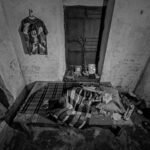
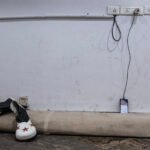
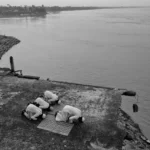
Traces is an ongoing body of work about people, festivals, animals and the land they share. Its images do not look recent. A pale horse walks across a field of black. Four children stand waist-deep in the sea, reduced to silhouettes against a grainy, mottled sky. A man looks straight at the camera while a small child, perched on his shoulders, rests a hand on his forehead. Each picture carries a surface of grain, smudge and uneven tone that suggests an old print kept too long in a drawer. That appearance is deliberate, and it took Marimuthu a while to arrive at it.
Things carried from childhood
Arun began with memories rather than a subject. Speaking about Traces, he described carrying recollections of the land, festivals, and daily habits from his childhood.
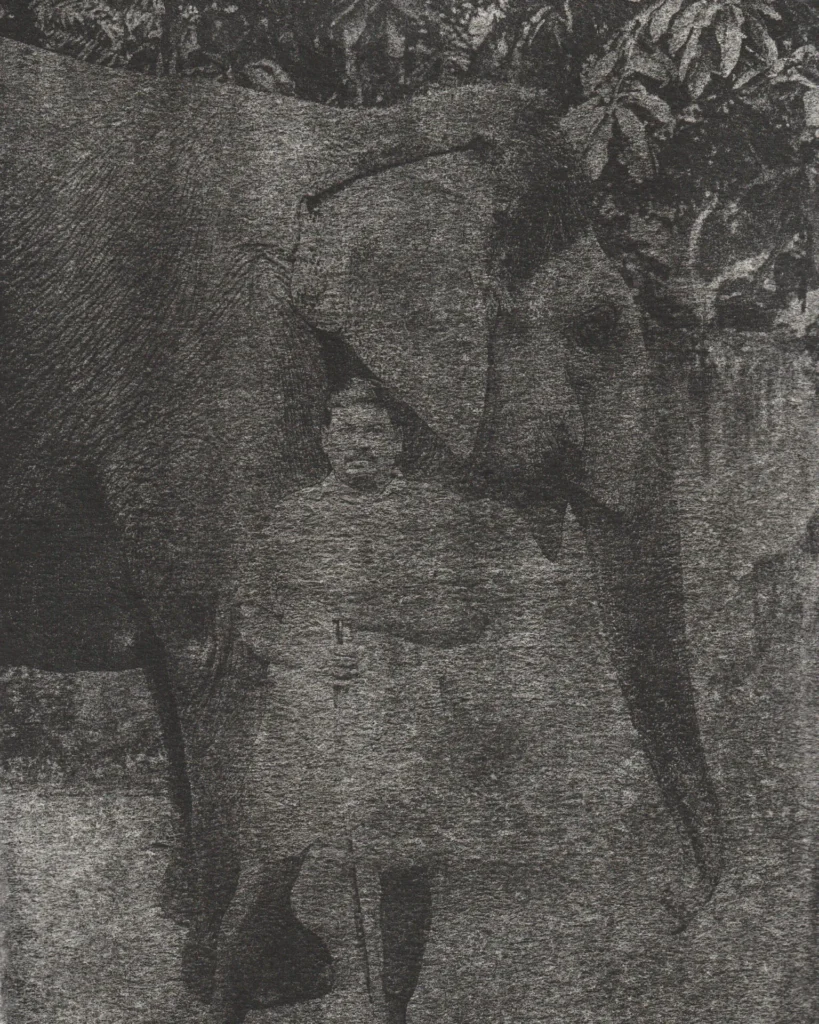
One memory he returned to was of people performing circus-like acts, involving bears, as part of their daily lives, something he watched as a small boy without a camera of his own. That culture, he said, no longer exists. What he still encounters are the animals, elephants and horses, and these he can photograph. In one print an elephant fills almost the entire frame, its ear and trunk enclosing a man who stands holding a stick. In another, a figure in a fringed, spiked costume appears only as a dark shape, one hand raised, every detail lost to shadow.
Landscape runs through the series as steadily as ritual. A lone figure stands beneath enormous fan-shaped palms. A leaning tree dominates a field while someone walks the narrow path below, carrying a load on the head. A person under an umbrella follows a small dog down a wet road. “I am not interested in extraordinary moments,” Marimuthu says. He looks instead for the ordinary ones that tend to go unnoticed but stay with people long after.
Finding the print
His first idea was to work with flames, which he says he has always liked, and to make images that looked archival rather than digital. The method came later. Around November or December 2025, he learned about Gumoil printing. He went back to his edited images and began testing what the process could do with them.
Gumoil was developed by the American artist Karl Koenig around 1990. A positive transparency is exposed onto paper coated with a light-sensitive gum, and oil paint is worked into the surface and wiped back by hand. Marimuthu pairs it with analogue photography because, as he writes, both demand patience. The slow process lets him spend time with each image and turns every negative into a unique print.
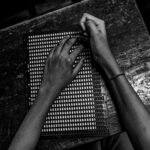
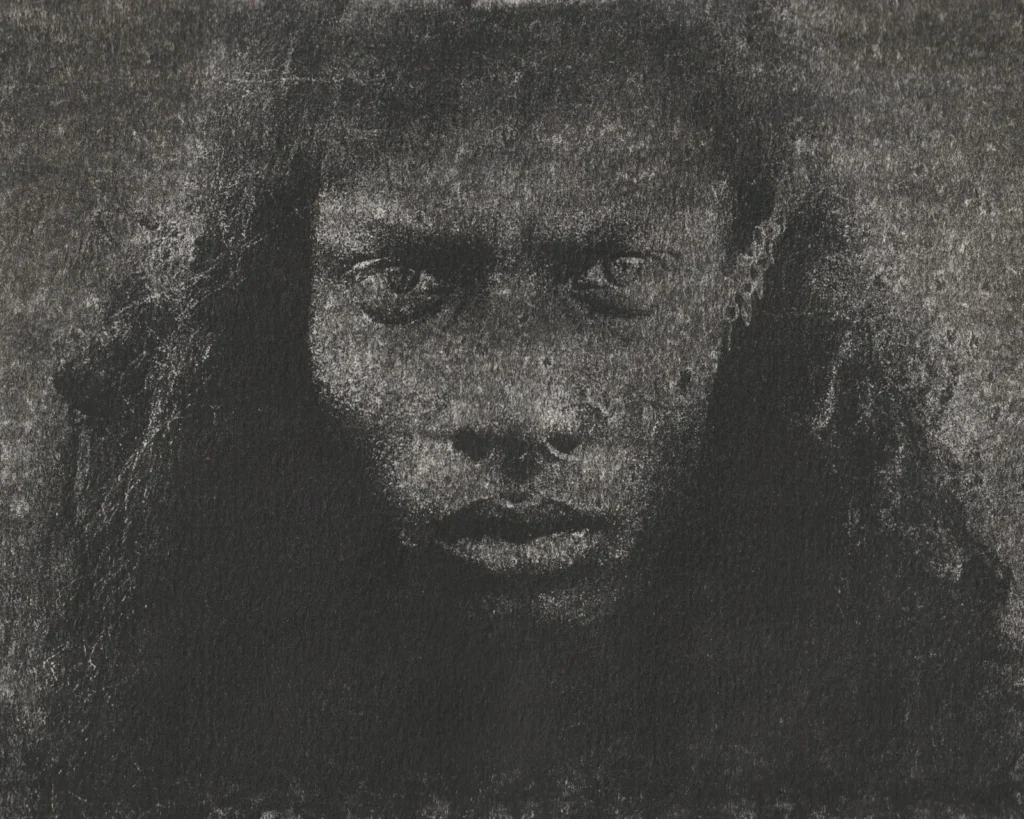
In the finished prints, brush marks run along the edges of several images. In a close portrait of a child, the eyes and mouth emerge from near-total darkness. In a photograph of two raised hands, stacked bangles at the wrists catch the light while the background breaks into speckled grain. Arun treats these textures and imperfections as part of the photograph, and in his statement he connects them to memory itself, which he calls “layered, fragile, and constantly changing.”
An archive still being made
Placed side by side, Arun said, the images link festivals, the memories attached to them and the memories bound up with the landscape. The pictures, he added, tell a story first of all to him, not to everyone.
Arun does not present the photographs simply as records of people or places. He calls them fragments of lived experience, concerned with belonging, remembrance and the lasting bond between people and their land. He wants to keep what he feels as well as what he sees.
He makes it clear that the project is just beginning and will keep growing, and he describes it as a lifelong practice of slowing down and observing more closely. Gumoil suits that ambition. It cannot be rushed, and no two prints are identical. The memories Traces sets out to hold behave in much the same way: built up in layers, returned to by hand, and altered a little each time they are revisited.
All images © Arun Kumar Marimuthu