(This Article is based on an exclusive interview of Photography Educator, Amarnath Praful with Indian Documentary Photo Collective)
There is a prevalent myth about photography that everything about the image comes to an end when the shutter stops clicking. You shoot, you edit, you publish, and whatever happens to the image after that is somebody else’s problem. Engage Amarnath Praful, curator and educator at NID Gandhinagar, in a discussion and that myth starts to look thin. For him, a photograph’s life properly begins the moment it leaves the frame. Everything before that is just the setup.
“The understanding of the photograph often begins when it leaves the frame, what is outside the photograph,” he says. That single shift in thinking, from photograph as object to photograph as circulation, says a lot about where documentary practice is heading. The archive used to be the place images went to rest. Increasingly, it looks like the place they go to keep working.
Nothing arrives from nowhere
Praful’s recent research at the V&A Museum involves what he terms “ocean as method”. It is a technique for understanding colonial photography archives through the process of maritime commerce instead of taking those archives to be tidy exports from empire to colony.. The chemicals in a daguerreotype had to be mined somewhere and shipped somewhere else before anyone could take a picture with them. The technology, the materials, the labour, all of it moved by sea long before the camera moved by hand.
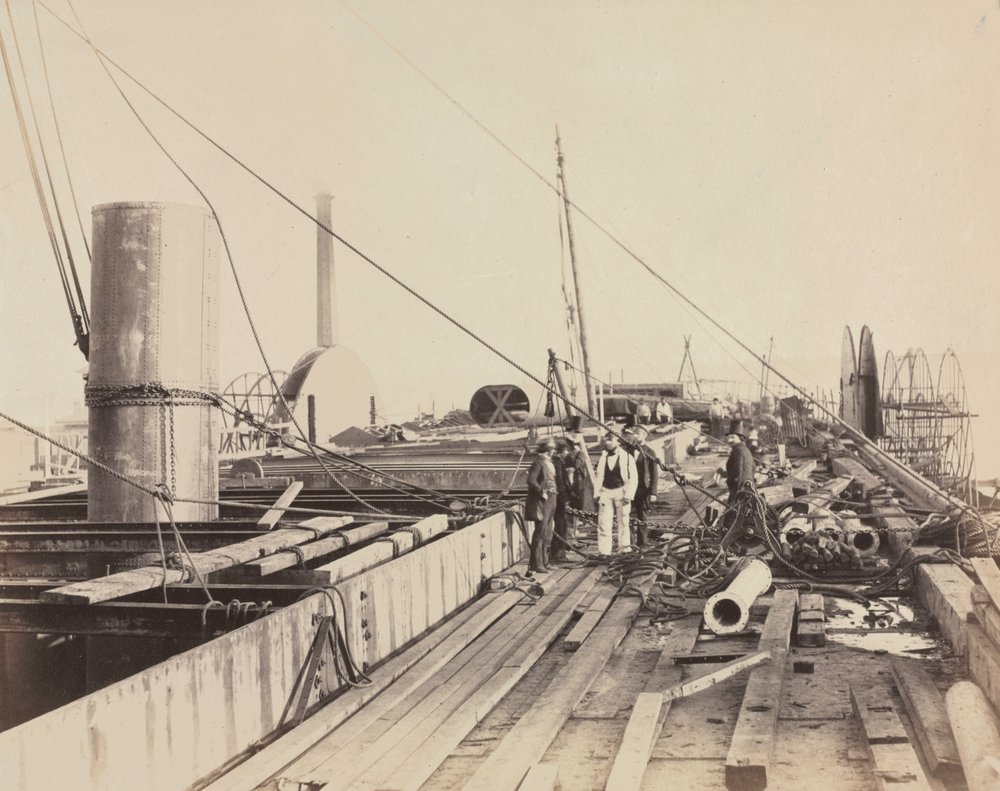
SS Great Eastern by Robert Howlett 1857 -1859
In this little reframe lies huge potential significance: a photograph is never actually produced in one place. It is assembled using materials and processes that have travelled across borders and even hierarchies of extraction prior to the process of photography itself. The proper reading of an image is always a question of where its ingredients have come from, not just what it depicts.
Praful’s work in Lakshadweep illustrates this almost to the letter. Many of the islands lacked photo labs, and thus film shot on Agatti and Kavaratti had to be sent to Kerala by ships to be developed, before being sent back after development. This meant that a photographer might take weeks to even see the photograph they had taken. Moreover, they would never have the opportunity to see the picture during monsoon season. That is a strange and useful thing to sit with: an archive can form before an image is even seen.
Reading against the Grain
The instinct to treat archives and “counter-archives” as opposites doesn’t hold up either. Praful brings up a set of 1860s studio photographs of Madras port, commissioned by one of the most successful colonial-era firms around. On the surface, they come across as typical imperial documentation. But sit with the image a little longer, and it starts working against itself. However, looking at the photograph in a bit more detail reveals its self-negating quality.
One realises who the British included in the frame and who they did not include, how the structure of the caste system of the era manifests itself even in a tiny detail like positioning people and focusing on certain buildings. All of that information was right there in the photograph, waiting to be noticed.
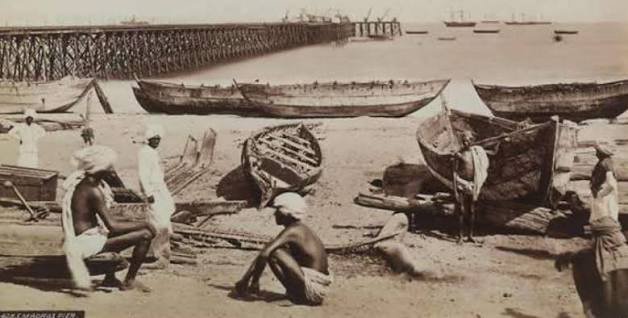
View from the pier, Madras by Francis Frith & co. 1850 – 1870
This is the type of perceptual acuity documentary photographers should possess nowadays, more so than an increased sense of composition. This is the ability to think about positioning and exclusion as signs, rather than aesthetic considerations, and wonder about whose gestures before the camera are genuine and whose are contrived. The visual surface of a photograph is only the beginning of the process of reading.
The physical world hasn’t left the chat
There’s also something to be said for slowing down in an era that rewards the opposite. Praful speaks of purposefully introducing physicality to the classroom — the smell of the darkroom, wet plates, the students working with a Salt print rather than scrolling past an image of it. It all comes back to being mindful of “the treachery of images,” which is how he refers to the ease by which an image can be taken at its surface value. The digital world we live in now trains most of us to glance at an image for half a second before moving on to the next.
Beyond the frame
None of this is an argument against taking pictures. It’s an argument against stopping there. The photographer-curator, a hybrid role Praful sees becoming more common, spends less time behind the camera and more time contextualising and editing, deciding what a body of images means once placed next to others. In his own words, “photographic interest is just 30 per cent, 20 per cent. It’s actually reading, it’s actually contextualising, editing, printing, putting it out.”
For anyone documenting the world right now, that’s the real skill worth developing. Not necessarily a better eye, but a slower one, which questions the origins of the photograph, the person who put it in place, and what they say once you stop seeing it and start looking through it.
All Images © Victoria and Albert Museum, London