(An article based on South African Photographer Tsephiso Mazibuko’s long-term project There’s Always Someone Looking)
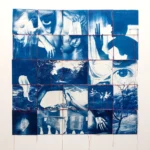
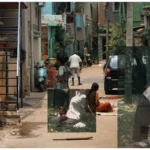
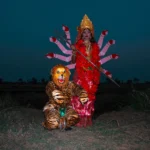
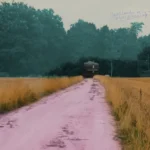
Tshepiso Mazibuko’s photographs in There’s Always Someone Looking (Zulu: Awukho umdlalo ongena babukeli) do not scream out loud at the viewer. They come soft and a little blurry, with people hovering vaguely at the edges of spaces and the atmosphere of an oddly timeless township that is hard to locate to any specific decade. Mostly, the series was made between 2020 and 2022.
This is something between a personal recollection and a reflection on photography history — something between an objective record of the place and a subjective record of being within it and knowing that there is always someone looking.

Early steps into private spaces
Mazibuko started early. Her first group exhibition ‘Encounters’, held at the Johannesburg Art Gallery, South Africa, in 2012, saw her walking around her community with camera in hand, stepping into people’s homes. As a fresh graduate from high school who didn’t quite know how the art world works yet, Mazibuko was simply searching for moments worth documenting and engaging with people. “It’s not easy for people to allow you into their homes,” she says. She needed a device that would allow her access, and the camera did exactly that. It led to a sort of intimacy and vulnerability as side effects. People would notice them much later in her photographs; all Mazibuko cared about at the time was presence in familiar surroundings, sometimes meeting strangers through the same lens.
This early openness to venture into private territory never really left. However, the motivations for taking photographs gradually changed. She became less fascinated with pure documentation and more intrigued with what the medium is capable of doing when pushed. The ready tag of being a cultural or documentary photographer was no longer appealing to her. She wanted a visual language that felt like her own.

Building an archive that pretends to be old
There’s Always Someone Looking began in response to a project organized by Magnum Foundation, a non-profit photographic foundation based in New York City. It requested South African photographers to engage with historical archives. The photographs that she came across in these archives were very frustrating for her because their eyes appeared empty and the photographs themselves seemed like voyeuristic attempts to capture reality. Rather than write a polite critique, she answered in kind. She created her own version of the archive.
She tried out expired film. Films that were used at first came totally down to luck. “I photographed the first few images by pure chance because I had forgotten an expired film in my camera and I went photographing. And then when I processed, I realized, oh snap, I used an expired film.” That deterioration produced graininess and blurred edges. Eventually, it became a conscious act. The photographs fool people into thinking that they were taken in the 1990s. More specifically, young people mistake the photographs for those from another decade. For Mazibuko, this kind of illusion is useful. “You can literally fictionalise everything in photography.”
“Once I’ve proved to myself that I could take a good photograph, it was no longer about composition or light; it was managing to get the feeling of being in that space or invoking a certain feeling.” She wants the image to suggest something beyond its own edges.

Beyond a single truth
Mazibuko is not demanding that her work can be defined politically. “I don’t claim to say my work is political. But it is highly political because first I’m a political being. By just existing…” she continues, “Being a woman, being Black, you know, that alone is a political statement in itself.” The representation of Black people has a heavy burden in history. Yet, the images cannot be reduced to slogans. “My work, more than anything, is quite suggestive. It’s never one thing. And if more than anything, it’s very dark. And it requires you to be emotionally available.”
She is processing film from that period, aware that with every new roll she brings yet another layer for years to come. She is also working on a small book of personal statements, never expressed on gallery walls, and considering a retrospective. Ultimately, the project brings her to an easy acceptance of there being no single truth. It is the mind that picks what it wants to see. And when the observer becomes the observed, the photograph starts to whisper on its own terms.